Showing posts with label Eazy E. Show all posts

Wednesday, February 19, 2025

Book: "Beyond South Central" legendary N.W.A. photographs by Ithaka Darin Pappas


The second edition of the 2016 photography book Beyond South Central (Sweatlodge Publishing) is now available on amazon.com. The book is the result of the three years Ithaka Darin Pappas freelanced for Priority Records, capturing the primary imagery of N.W.A., documenting almost the entire lifespan of the group, from their obscure South Central beginnings to their meteoric rise to controversial super-stardom. This publication includes iconic images such as The Miracle Mile Shot, The Bleacher Shot, Backstage In Phoenix and also rarely seen candid images of Ice Cube, Dr. Dre, Eazy E, MC Ren, DJ Yella and The D.O.C.

Ithaka Darin Pappas began experimenting with his father's 35mm and medium-format film cameras as early as age 5. He started assisting professional photographers immediately after high school, and within a year, began publishing much of his own work. Perhaps the most published (and republished) commercial photographic works by IDP are his early archival images of the influential LA Gangsta rap group NWA. Pappas worked for the West Coast record label Priority Records between 1988 and 1991 and documented almost the entire lifespan of the group, from their obscure South Central beginnings to their meteoric rise to controversial super-stardom.

Monday, March 29, 2021

Friday, April 26, 2019

Rare Eazy E photograph by Ithaka Darin Pappas shown at Annenberg exhibit, "Contact High"

“Contact High: A Visual History of Hip-Hop,” at the Annenberg Space for Photography. A new group show organized by author Vikki Tobak looks at the work of photographers who chronicled the rise of hip-hop, with famous prints (like the iconic portrait of Biggie Smalls in a crown by Barron Claiborne) as well as unedited contact sheets and other images of key musical figures from the genre, including Eazy-E, Jay-Z and Salt-N-Pepa. Tobak is the author of the bestselling book on which the exhibit is based. Opens Friday and runs through Aug. 18. 2000 Avenue of the Stars, Century City, AnnenbergPhotoSpace.org.
Rapper Eazy-E skateboarding in 1989 is among "Contact High" images.
Rapper Eazy-E skateboarding in 1989 is among "Contact High" images. (Ithaka Darin Pappas)

Wednesday, September 13, 2017

Contact High Exhibit's Unusual Eazy E Skateboarding Photograph By Ithaka Darin Pappas at 2017 Photoville in Brooklyn, New York


[Contact High: Hip-Hop’s Iconic Photographs and Visual Culture]

Rapper, Eazy E skateboarding in Venice Beach, California Feb. 24th 1989 - photographed by:Ithaka Darin Pappas

Presented by
Contact High with support from Mass Appeal and Invictus Black

Curated by
Vikki Tobak; Associate curator: Syreeta Gates
“Contact High” spotlights the photographers who have played critical roles in bringing hip-hop and music culture imagery onto the global stage. Photographers share their era-defining stories’ iconic images, what legendary street photographer Henri Cartier Bresson called ‘The Decisive Moment’. “Contact High” offers a rare glimpse into the creative process and a behind-the-scenes look at the making of the imagery that shaped hip-hop and music visual culture. Getting access to the original and unedited contact sheets, we see the ‘big picture’ visual legacy being created. Contact sheets let you look directly through the photographer’s lens and observe all of the other shots taken during these legendary moments.
Hip-hop and rebel cultures have always been about self-definition, especially when it comes to visuals and style. For artists, that one iconic pose, press shot or album cover would play a major role in shaping them into icons by any means necessary—skills, style, swagger, bravado and visuals. Today, the way we digest and create cultural imagery has radically changed. Today’s visual landscape is haphazardly shaped from every direction. The contact sheets reveal how photographers shaped the evolution of a visual cultural phenomenon.
Let’s get analogue for a minute. Contrary to the iPhone’s dominance, film is not dead. In fact, there’s a whole movement of analogue film photographers hashtag bragging: #FilmIsNotDead #35mm #ishootfilm #analogphotography #analogvibes… the list goes on. In this digital age of Instagram and Photoshop, it’s easy to hide imperfections. Analog film reveals beauty and individuality by exposing imperfection and process. There is individualism and eccentricity in every shot, like the dust and grooves of vinyl records. Photographers typically don’t show their contact sheets. It’s their visual diary. Not every shot worked, in fact, most didn’t. Back when every photo was methodically shot on analog film, the negatives on a roll of film would be contact printed on photographic paper allowing you to see the full range of images that would eventually develop into the ‘money shot’.

ORGANIZATION BIO

“Contact High: Hip-Hop’s Iconic Photographs and Visual Culture” spotlights the photographers who have played critical roles in bringing hip-hop and music culture imagery onto the global stage.
The exhibition encompass more than 40 years of history and celebrates what and how photographers saw as hip-hop evolved into a global force. Coinciding with the publication of “Contact High: Hip-Hop’s Iconic Photographs and Visual Culture” (Clarkson Potter/Penguin Random House) to be published fall 2018.

Source: http://photoville.com/contact-high-hip-hops-iconic-photographs-visual-culture/

Sunday, November 6, 2016

EAZY E _ Ithaka Darin Pappas's Iconic Hip Hop Imagery

https://www.generaladmission.us/blogs/news/eazy-e-and-ithakas-iconic-photo

Eazy E, N.W.A and Ithaka Darin Pappas's Iconic Imagery


We all have a friend like Ithaka Papas; he’s the one everyone's jealous of. The guy who picks up sports quicker than anyone. That friend who hears a tune once and can play it on any instrument and he also happens to tell the best stories all-the-while completely nonchalant about the said above. He's that guy that you want to hate on but you just can't. When I first met Ithaka six years back, he came over to my pad with a little point and shoot camera. He snapped a few pics while we were hanging out. I didn’t think anything of it. We later went surfing and I was blown away by his ability in the surf. I got to know him, and he was an unraveling onion. Each layer was a wild adventure; his life was coated with wonder. And, it wasn’t until the feature film Straight Out Of Compton landed in theaters that I learned Ithaka had spent two years with N.W.A. He had shot their album covers, editorial and more. Fascinated by our cover photo of Eazy-E in Venice I grabbed him for the real story and the back story on a few of his other favorite pics.
All photos courtesy of Ithaka Darin Papas/Tack Artist Group
GA: Tell us about the cover photo and how you got to that point with N.W.A?
Ithaka: At the time I was working for Priority Records. I was their main freelance photographer during this period and I had photographed N.W.A. probably more than any other photographer. This particular day was a shoot for MTV and they were doing a little culture clash unite between this pop group Kris Kross and N.W.A. Kris Kross came down and we all met in Venice. Fab 5 Freddy did the interview, an old-school artist and hip-hopper from New York. After the Kris Kross bailed we all walked down to the skate area down there on the beach at Venice. Eazy grabbed some kid's skateboard and took off. I'd already been working with this crew for probably almost two years and I'd never even heard the word skate board came out of anybody's mouth, or surfing, or anything like that. It was a shock to me, and he'd obviously spent some time on a skateboard because he knew what he was doing. 

GA: He could skate? 
Ithaka: Yes. He was confident on it. One thing we've learned from this photo is Eazy is a goofyfooter. (Ed’s note: Goofyfoot is the type of stance a surfer or skater is defined by) 
GA: Back then Venice was still pretty hardcore, we’re people excited to see Eazy, or was he getting a few scary looks? 
Ithaka: No, they were super excited to see him. But during that period there were a lot of gang conflicts here. A lot of these shoots that I did with N.W.A., we'd go to a place and there'd be a mixed reaction. I don't think anybody specifically from the band has ever been an affiliated gangster, but friends of theirs are and that ends up being a co-affiliation. Sometimes they'd go to these shoots and there would be some vibe from whoever. But generally speaking it was just excitement, it was a big deal, Eazy-E was down on the beach, he was signing autographs non-stop, and girls were screaming, they were big stars. 
GA: Anything else exciting happen that day?
Ithaka: Not really, that was it. We just went down there and everyone went their separate ways. I did another little shoot with Dre and DSC after this. These were good shoots because they were very informal so you could get good material and everybody in their element, that was my specialty, going where they were shooting a video, then doing a portrait session on the side, that kind of thing. It's hard to get everybody together in the same space, like, "Okay, we're going to have a photoshoot out of the studio." It's hard to get them together and focused for more than a couple minutes at a time.

GA: You also shot Eazy E's famous pool party from the movie Straight Outta Compton?
Ithaka: I did not shoot the pool party but I went to the pool party. Way better to participate in that one than photograph it [laughs]. That was pretty nuts, it was at some ranch up in Malibu. No holds barred, they put on a serious party. You know, the great thing about "Straight Outta Compton", you know I'm sure you know people that were even more involved than me might see subtle details that weren't accurate from my perspective, it was exactly the way I remember working with them, the portrays of them.
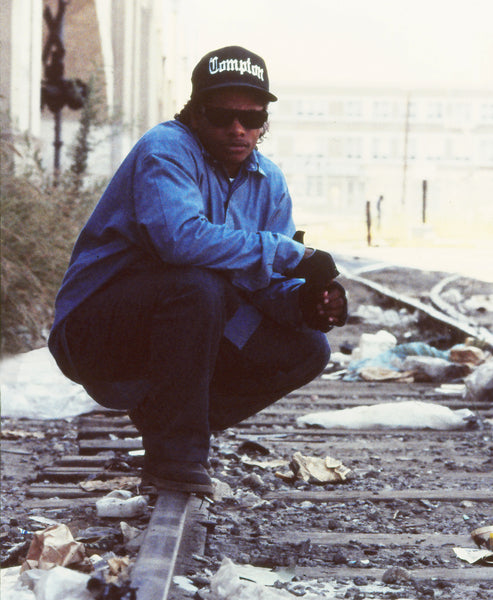
GA: Let's go through some other photos. Tell me about this one of Eazy on the train tracks.
Ithaka: This was on the east side of downtown LA. Once again, it was myself doing promotional portrait stills on the side of a video shoot, and in this case, this was the video for “100 miles and running”. This was when Ice Cube already left the band. This was the second N.W.A. album. So, this was towards the end of the project because Ice Cube had already left the band a few months before, so it just totally changed the direction of the project.

GA: What a bummer. This one of him here is my favorite of the four. He looks so young.
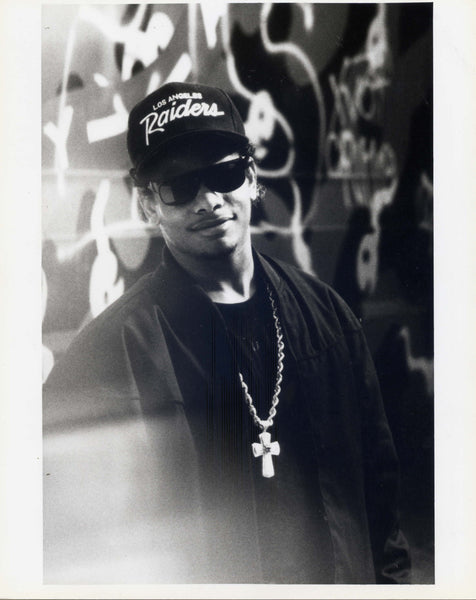
Ithaka: So, this was, I think it was November 1988. This was the first time I had ever met any of these guys. This was the record cover shoot for “We want Eazy” the single, which just had the song “Radio” on it. So, this shoot was mostly about Eazy. Everybody was there though, so also there's some shots of N.W.A from the day. This is at my apartment on Orange Street near Wilshire and San Vicente. So, this one it was a little bit more produced. I think I got 500 dollars for this shoot and I’m sure I spent more than 600 dollars shooting it. But I didn't care I was so excited to shoot them. (Continued below) 

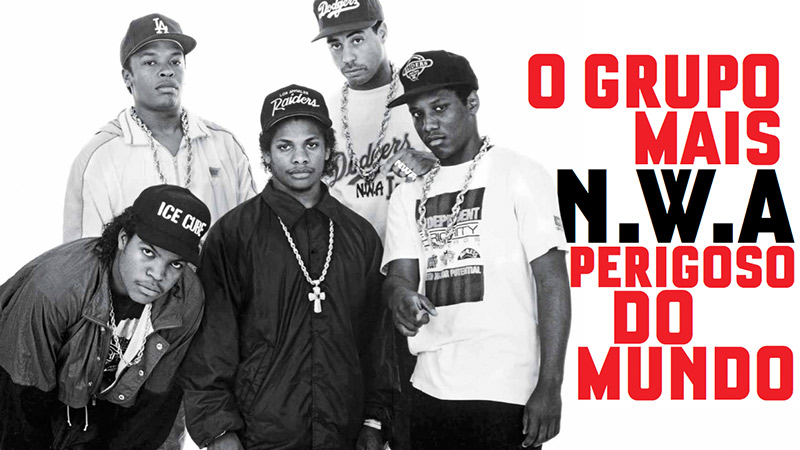
Ithaka: I was a fan of these guys as well. I was a daily listener to K.D.A.Y. I knew the music very well before I ever even worked with N.W.A. or Eazy. So, it was like I knew what I was getting into and I wanted to do a good shoot, and one of the shots from this shoot had all five members, they gathered without their sunglasses, and the image is one of the images that has survived the test of time. Because it’s really rare to see everybody without their sunglasses in controlled lighting.
GA: I remember you telling me a funny story about the catering for the shoot?
Ithaka: Oh, yes. This was Clarity Records and the only records they had really done before this was the California Raisins. You know, the California Raisins?
GA: Yeah I saw it in the movie.
Ithaka: They went into hip-hop and they were treading lightly. Unsure of how it was going to turn out they didn’t want to spend too much money. So the catering for the shoot was four bags of Doritos and a 24 pack of Old English 800.

GA: It’s crazy how young they are here, man. They’re just kids. Eazy would have been what age?
Ithaka: He might have been 20, so let me think. Dre’s a year older than me, ’88, how old was I? So, I was 22, Dre was 23, Cube is like 20-21.
GA: Insane. Fuck, that's such a good photo.
Ithaka: Fun shit though, huh?
GA: Yes, it’s such cool shit, man. Okay last one, what about this one below. 
Ithaka: Yes, this was down at MacArthur Park. This was another segment for MTV. This was the record cover shoot for the single "12-inch", extended version of “Express yourself”. Which also had "A bitch is a bitch" on it. This was the cover of that. At the time MacArthur Park used to be a pretty rough neighborhood. I think they'd just drained the lake right before this. They found 700 guns in the lake, 3,000 knives, couple dead bodies. I don’t know what it’s like now down there now but I imagine a lot nicer. 


__________________________________________________
https://www.generaladmission.us/blogs/news/eazy-e-and-ithakas-iconic-photo
 

Tuesday, September 29, 2015

N.W.A - O GRUPO MAIS PERIGOSO DO MUNDO (fotografia por: Ithaka Darin Pappas)


Nova Blitz traz CD de DJ Ride e 10 páginas sobre N.W.A.

A nova edição da revista Blitz, que amanhã chega às bancas, tem múltiplos pontos de interesse para os leitores que seguem o universo explorado pelo Rimas e Batidas: a começar num CD de título Remixes & B Sides onde se reúne uma série de trabalhos dispersos de DJ Ride. São 17 faixas ao todo, incluindo trabalhos de remistura para artistas como Legendary Tigerman, Gentleman, Capicua, HMB ou Batida e colaborações com Beatbombers ou o irmão Holly e ainda inéditos ou versões alternativas de temas já conhecidos e editados em nome próprio. A acompanhar este CD há uma entrevista de Mário Rui Vieira e uma passagem do próprio DJ Ride por cada um dos 17 temas que se incluem neste disco.
Há mais pontos de interesse nesta edição: os míticos N.W.A. de Dr Dre, Eazy-E e Ice Cube, que inspiraram o blockbuster americano Straight Outta Compton que por sua vez inspirou Compton: A Soundtrack com que o produtor do mítico The Chronic quebrou um longo silêncio, merecem um longo artigo de 10 páginas da autoria de Rui Miguel Abreu (director desta vossa casa). Há ainda uma entrevista com Darin Pappas, o mentor do projecto Ithaka que deu cartas na cena hip hop nacional nos anos 90, que tem a particularidade de ter fotografado os N.W.A. na época em que vivia em Los Angeles, no final dos anos 80.
Para lá destes dois óbvios argumentos, a Blitz de Outubro inclui ainda uma entrevista de fôlego com Carlão e várias críticas a discos do universo hip hop/electrónico. Edição a não perder, portanto.

http://www.rimasebatidas.pt/nova-blitz-traz-cd-de-dj-ride-e-10-paginas-sobre-n-w-a/

Monday, August 24, 2015

EAZY E: Cover Of POLLSTAR Magazine - Feb. 1989 / Photo: Ithaka Darin Pappas


Eazy E - aka Eric Wright (1963-1995) - Photo: © ithaka darin pappas 

Cover of Pollstar Magazine - February 1989
http://www.pollstar.com/

Shot from my infamous Miracle Mile shoot 
with Eazy-EN.W.A & Big Lady K - in 1988.

For more information about this image please contact: ithaka.art@gmail.com - Also see: @_ithaka_


EAZY E - "We Want Eazy" - cover by Ithaka Darin Pappas


Eazy E photographed by Ithaka Darin Pappas 
in Los Angeles (1988) 
for the cover of his 12" single "We Want Eazy"

https://en.wikipedia.org/wiki/Eazy_E

-------------------------------------------------

For more information about this image please contact: 
ithaka.art@gmail.com - Also see: @_ithaka_

EAZY E - 1988: Photographed by Ithaka Darin Pappas


Eazy E - aka Eric Wright (1963-1995) - Photo: © ithaka darin pappas 

One of the original proof sheet from my infamous Miracle Mile shoot 
with Eazy-EN.W.A & Big Lady K - in 1988.

For more information about this image please contact: ithaka.art@gmail.com - Also see: @_ithaka_


Sunday, August 23, 2015